Code Name
A four-hero action game seen from above. The whole party shares one screen like Secret of Mana, fights and loots like Diablo, and runs dungeons like World of Warcraft. Underneath it all is Trixie's idea: one energy bar the team shares, and a hero whose job is to keep it full.
The game in one table
| Item | Decision |
|---|---|
| Name | "Code Name" for now. Options in section 12. |
| Genre | Co-op action role-playing game |
| Camera | From above, like Diablo |
| Screen | One shared screen for the whole party, like Secret of Mana |
| Players | One to four. Computer-controlled heroes fill any empty seats. |
| Dungeons | World of Warcraft style: packs of enemies, then bosses with a trick to learn |
| Loot | Diablo style: lots of drops, often |
| Story | Trixie's. It never ends; it grows chapter by chapter. |
| Look | Stylised 3D. Chunky sci-fi heroes in a stone fantasy world. |
| Signature idea | Shared team energy, refilled by crowd control and by the Battery |
| First release | One outpost and one dungeon |
| Public page | "Coming soon", with the art and the four roles only |
What we take, what we leave
Take: the party together on one screen. Friends drop in and out. Each hero has a clear job. Attacks you charge, so timing beats mashing. A warm, colorful world.
Leave: the name and anything else that belongs to its makers.
Take: the camera from above. Crowds of enemies. Skills on short timers. Loot that drops constantly.
Leave: the grim tone, and the giant always-online world.
Take: roles that need each other. Enemy packs that lead to bosses. Bosses with a trick the group must learn.
Leave: the behind-the-shoulder camera and the huge open world, for now.
The three fit because Trixie's shared energy only works when players can see each other. One screen makes the Battery's job visible. The camera from above keeps a 3D game small enough to build.
Eight answers
| Question | Answer |
|---|---|
| Camera | From above |
| One screen or four | One screen |
| Loot | Diablo style |
| Who writes the story | Trixie |
| Sci-fi heroes in a fantasy dungeon | Yes. Everyone likes the mix. |
| Name | "Code Name" for now, changed later |
| Public page | Coming soon |
| Fewer than four players | Solo, two or three all work. Computer heroes sub in. |
How we got here, in Trixie's words
What if we did a semi-offline world where you could invite friends too, but the main multiplayer part was the dungeons.Trixie, 4 October
That way we could start small, one zone and one or two dungeons, then we grow, adding both slowly.Trixie, 4 October
I want to aim to WoW adjacent. And what do you feel about more sci-fi.Trixie, 4 October
Erick offered the Secret of Mana twist on the option 2 art, where each player picks a hero and plays their part. Trixie: "That would be cool."
Four roles. One shared energy.
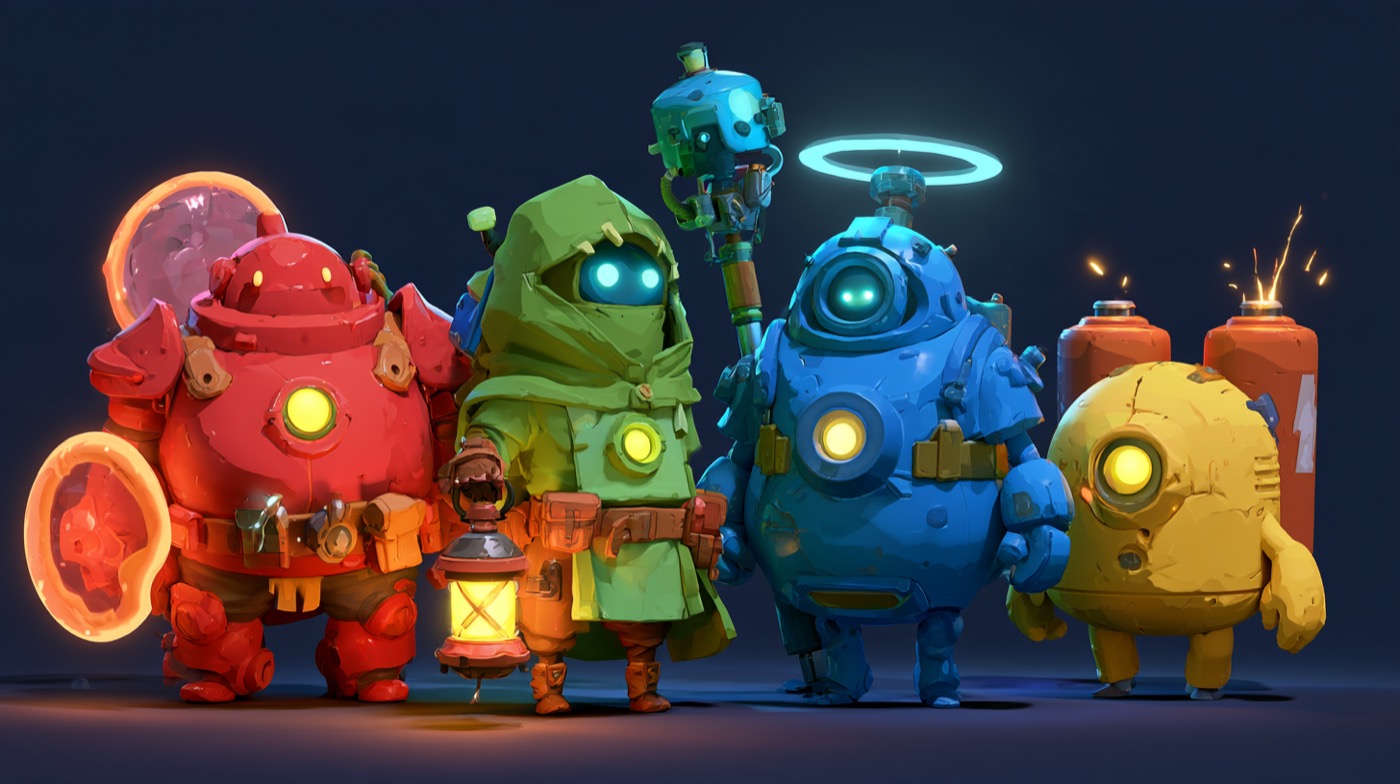
Holds the enemy's attention and survives it. Heavy aggro, takes a hit, weakens the enemy.
Keeps the party's health up and strengthens the team.
Shapes the fight with crowd control. Higher damage.
The energy healer. Keeps the party's energy up. High damage.
The energy loop
Energy belongs to the team, and crowd control is what refills it. Controllers and Batteries fuel everyone's skills, so no role can be skipped.
Six classes, every pair of roles once
| Class | Tank | Healer | Controller | Battery |
|---|---|---|---|---|
| Paladin | Yes | Yes | ||
| Druid | Yes | Yes | ||
| Warlock or Techlock | Yes | Yes | ||
| Alchemist | Yes | Yes | ||
| Priest | Yes | Yes | ||
| Mage | Yes | Yes |
Each role appears in three classes, so none is harder to fill. "Preset" in the concept document is read as Priest. With a sci-fi lean, Techlock fits better than Warlock. Trixie to confirm both.
One screen, four jobs
Everything in this section is PixelBattle's proposal for how the three references and Trixie's rules combine. It is here for her to change.
The camera follows the party, not one player. Nobody can run off alone, so everyone always sees the energy bar and each other.
From Secret of Mana: hold to charge a stronger attack. Charging costs team energy, so a greedy player drains everyone.
From WoW: the Tank gathers a pack, the Controller locks it down, and the energy that comes back pays for the big skills.
From Diablo: enemies burst into gear. Drops are tinted in the four role colors, so you can see what is yours at a glance.
The energy bar is the fifth character
One wide bar sits at the top of the screen for the whole team. It glows when crowd control lands and flickers when it runs low. When it is empty, nobody has skills, and the party has to control something to get it back.
Computer heroes fill the seats
A dungeon always has four heroes. Friends take as many as they like and the computer plays the rest.
| Players | How it works |
|---|---|
| Solo | You play one hero and the computer plays three. You can switch which hero you control at any time, as in Secret of Mana. |
| Two or three | Each friend picks a hero. The computer covers the missing roles. |
| Four | Every hero is a person. This is the game at its best. |
| Joining late | A friend can take over a computer hero in the middle of a dungeon. |
Computer heroes should be competent but plain. They do their job and never make the clever play. A human in the Battery or Controller seat should always feel the difference.
It never ends
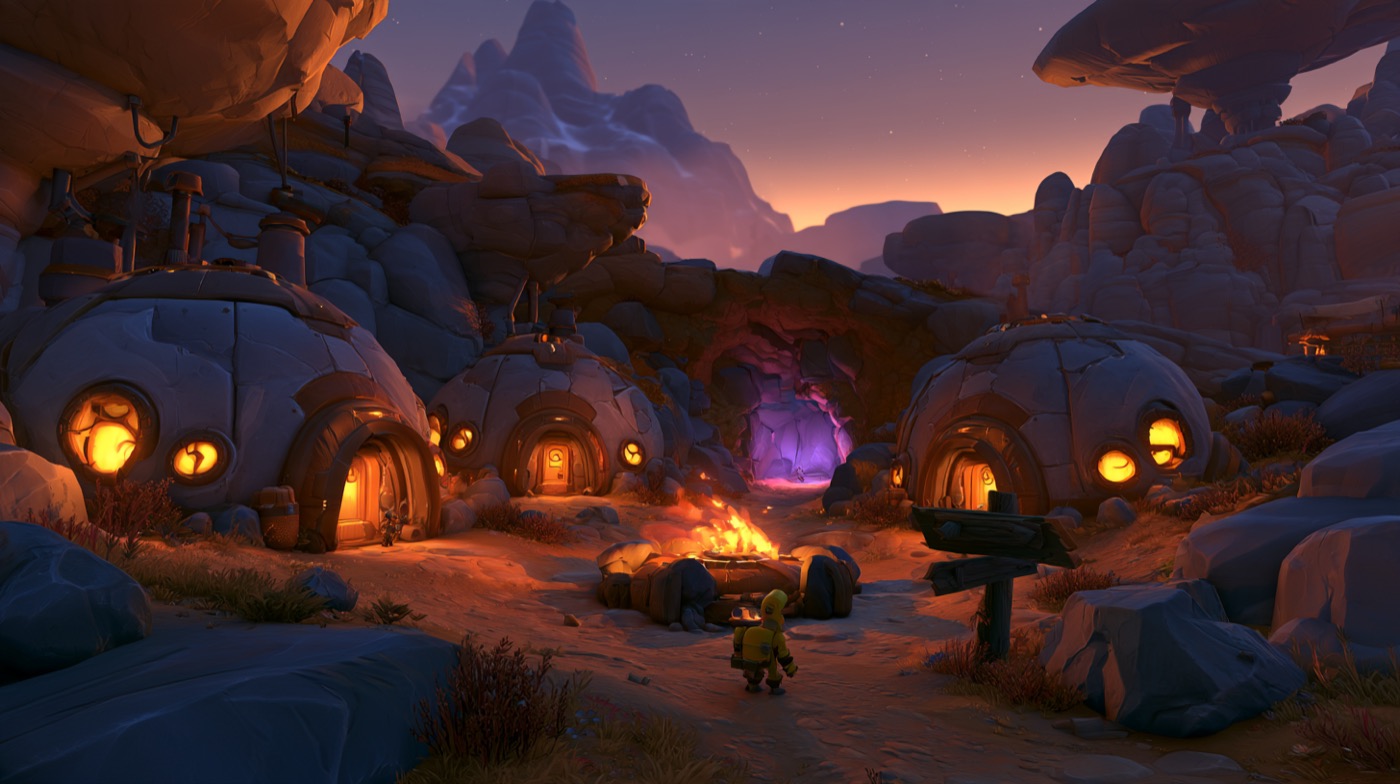
Home. You can walk it alone with no connection, or invite friends in. It is where you gear up, swap class, hear the story and choose a dungeon.
The multiplayer part. Packs, a boss or two, and loot. Each one teaches a new way to use the energy loop.
A story that keeps building
Trixie writes it. The story arrives in chapters, and every chapter adds something you can play: a dungeon, a boss, a new corner of the outpost. The world remembers what happened, so the outpost changes as the story moves.
The original design grows by adding new worlds rather than new regions of one map. That is how a never-ending story stays buildable: each chapter can be a new world with its own rules, without rebalancing the old ones.
How difficulty scales, from the original design
| Content | How it scales | Why |
|---|---|---|
| Zones, mode 1 | Zone level and gear rise with the player | The world stays challenging at any level |
| Zones, mode 2 | You can out-level the zone; gear does not scale | You feel your growth and clear old areas fast |
| Dungeons with matched players | Dungeon and its gear always scale to the group | New players get the full experience, not a rush |
| Dungeons with your own group | You may out-level it and carry friends | Helping friends stays possible |
| Endgame dungeons | Players can modify them and raise the difficulty | Veterans have a reason to come back |
The first release needs only the "own group" rule. The rest arrives as the game grows.
Small enough to finish
One outpost. One dungeon with a few packs and a boss. Four roles. Four classes. One to four players with computer heroes. Loot. Chapter one of the story.
Matching with strangers. Zone scaling modes. Endgame modifiers. More worlds. Trading, guilds and chat. Player against player.
Recommendation: launch with four of the six classes
Paladin, Mage, Druid and Priest. Between them every role appears exactly twice. Alchemist and Techlock arrive with chapter two. The choice is Trixie's.
One run, start to finish
Chunky heroes, four colors
Stylised 3D with hand-painted textures. Heroes are short, round and readable from above: one strong color each, a glowing chest core, one signature tool. Red tank with an energy shield. Green hooded medic with a lantern. Blue controller with a tech staff. Yellow battery throwing sparks. The world is old stone lit warm orange and cool teal. Purple always means danger.
The same four colors and purple glow run through One Button, so both games look like one studio.
Prompts for the next round of art
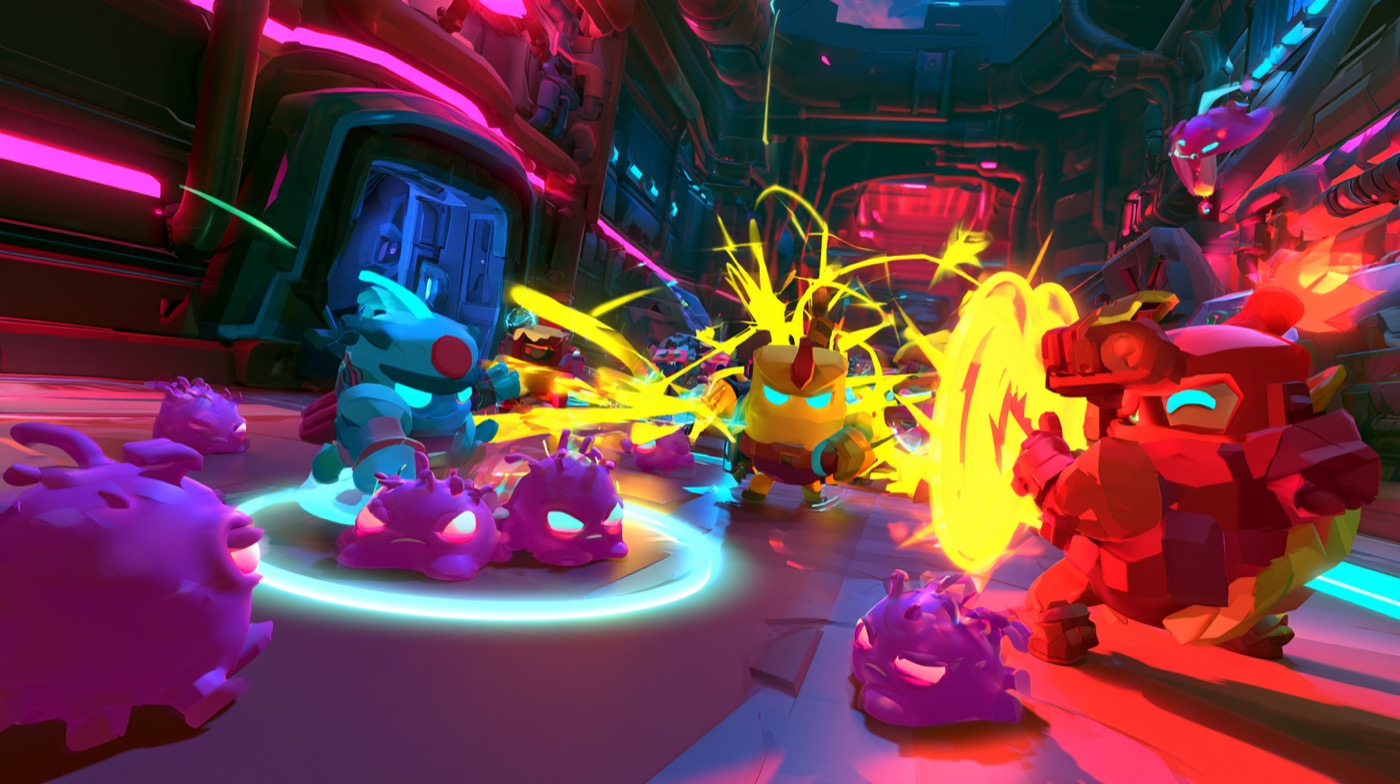
Gameplay from above: stylized 3D game screenshot, isometric camera looking down like Diablo, four chunky rounded sci-fi heroes together in an ancient stone dungeon room (red armored tank with a glowing energy shield, green hooded medic with a lantern, blue controller with a tech staff, yellow battery-shaped hero throwing sparks), fighting a pack of small purple blob enemies, the blue hero traps three enemies in a ring of light, yellow energy arcs from the yellow hero to its teammates, loot glowing on the floor, hand-painted World of Warcraft style textures, warm orange and teal lighting --ar 16:9 --no text, interface, logo, watermark, photorealism
Boss room from above: stylized 3D game screenshot, isometric camera, the same four chunky sci-fi heroes facing one huge purple stone guardian with glowing eyes in a round dungeon chamber, the red tank in front with shield raised, the others spread behind, hand-painted textures, dramatic purple and orange lighting --ar 16:9 --no text, interface, logo, watermark, photorealism
Outpost from above: stylized 3D game environment, isometric camera, a small outpost of round stone huts with glowing windows around a campfire at dusk, a signpost, a cave mouth with a purple glow, the four chunky heroes resting by the fire, hand-painted textures, warm and calm --ar 16:9 --no text, interface, logo, watermark, photorealism
Platform and plan
Godot is the recommendation: free, capable of this kind of 3D, and it exports to computers and to the web from one project. To be confirmed in step 2.
Computer first, then Steam. A browser version on pixelbattle.net if step 2 shows 3D runs well enough there.
One screen makes couch play free: four controllers, one computer. Online play by room code comes next, with every player seeing the same view.
Steps
- Design sign-offTrixie answers the open questions and names the launch classes.
- Combat toyOne room seen from above. Four grey-box heroes, one pack, the shared energy bar working. Also the engine and browser test. If this is not fun, nothing else matters.
- Computer heroesSolo play with three computer teammates, and switching between heroes.
- First dungeonA few packs, one boss, loot. Couch play for up to four.
- Outpost and chapter oneThe home zone and the first piece of Trixie's story.
- Online and launchRoom codes, then a public release with its own page and trailer.
- Keep buildingChapter two: a new dungeon and the last two classes.
Each step ends with Trixie playing the build and deciding whether to go on.
Who does what
| Person | Role | Owns |
|---|---|---|
| Trixie Ingleby | Narrative Director | The design, the world and the story |
| B Ingleby | Creative Director | The look: heroes, colors, key art |
| Erick Ingleby | Founder and Studio Director | The build, testing and publishing |
Open questions
- The Battery in a fight. How does it restore energy? By channelling, by hitting enemies, or by standing near allies?
- Energy and crowd control. Does crowd control refill the whole team's bar, as this brief assumes?
- Battery classes without healing. Druid and Mage restore energy but not health. Intended?
- Class names. Is "Preset" Priest? Techlock rather than Warlock?
- Launch classes. Are Paladin, Mage, Druid and Priest the right four?
- The story. Who are these four, why are sci-fi heroes in a stone dungeon, and what do the purple eyes want?New
- Chapters. How often should a new chapter arrive, and how big is one?New
- Charging attacks. Should charging cost team energy, as section 5 proposes?New
- Loot. Is gear tied to a class, or can anyone wear anything?New
- Losing. What happens when the whole party goes down?
- Length. How long should one dungeon run take?
- Name. Which code name, and what is the real one?
What to call it for now
A code name is only for us. None of these has been checked against existing games or trademarks, and the real name will need that check.
The Battery and the shared energy, in one word.
Four heroes, four power cells, one circuit.
The medic's lantern and the light at the dungeon door.
Named for whatever is waiting in the dark.
Where every run starts and every chapter lands.
Energy passed from hero to hero.
What could go wrong, and what to play
Every hero needs a model and animations. The camera from above and chunky shapes keep that as small as it can be.
A bad computer healer ruins solo play. Step 3 exists to get this right before any content is built.
Players will expect chapters. Decide a pace the three of you can keep before announcing it.
Shared energy is new and untested. Step 2 finds that out cheaply.
Worth playing before sign-off
| Game | What to look at |
|---|---|
| Secret of Mana | The shared screen, charged attacks, switching heroes, computer teammates |
| Diablo 4 | The camera, enemy crowds, how loot feels |
| A World of Warcraft dungeon | Packs, pulls and one boss with a trick |
| Children of Morta | A home base with story between dungeon runs |
| Deep Rock Galactic | Four roles that truly need each other |
| Minecraft Dungeons | A Diablo-style game made friendly, with chunky characters |